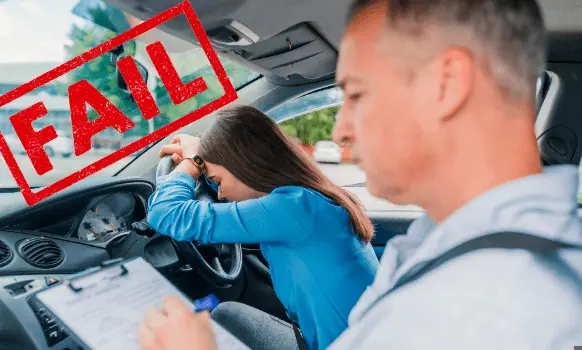

The most common reason people fail the driving test in Great Britain is not looking properly at junctions. It has topped the DVSA’s list for years, ahead of mirror checks, moving off and turning right.
The DVSA publishes the 10 faults that fail the most car tests. The latest list covers tests taken from April 2024 to March 2025. Most of these are not difficult skills. They are habits that slip when you are nervous, so knowing them in advance is the easiest way to avoid them.
Below is each fault, what the examiner is looking for, and how our instructors help learners in Manchester get it right.
How the Driving Test Is Marked
You pass if you get no more than 15 driving faults (often called minors) and no serious or dangerous faults (majors). One serious fault is enough to fail, even if the rest of the drive is perfect.
That is why the faults below matter so much: most of them become serious faults when they put another road user at risk, for example pulling out in front of a car you didn’t see.
The Top 10 Reasons for Failing the Driving Test
1. Not making effective observations at junctions
This is the number one reason people fail. It means pulling out without looking properly, or looking but not judging the speed of an approaching car. How to avoid it: slow down early so you have time to look right, left and right again, and creep forward at closed junctions where hedges or parked cars block your view.
2. Not using mirrors correctly when changing direction
Examiners want to see mirror checks before you signal, change direction or change speed. How to avoid it: use the routine Mirrors, Signal, Manoeuvre every time, and check the door mirror on the side you are turning to.
3. Not moving off safely
Moving off from the side of the road, on a hill or from behind a parked car without checking your blind spot is a common fail. How to avoid it: check both mirrors and look over your right shoulder every time you move off, even if the road looks empty.
4. Incorrect positioning when turning right at junctions
When you turn right, the car should be just left of the centre line so traffic can pass on your left. How to avoid it: position early, and in a box junction or at traffic lights wait in the right place until the turn is clear.
5. Not responding appropriately to traffic lights
This includes going through on amber when you could have stopped, stopping over the line, or not moving when the light is green and the road is clear. How to avoid it: watch lights as you approach and ask yourself whether you could stop safely if they changed now.
6. Not having proper control of the steering
Steering too late, too early or too much, and clipping the kerb, are all steering faults. How to avoid it: keep both hands on the wheel, use the pull-push method, and look where you want the car to go.
7. Not responding correctly to road markings
Driving in a bus lane during its hours, ignoring lane arrows or stopping in a yellow box junction are typical examples. How to avoid it: read the markings early, especially on multi-lane roads and big roundabouts, and choose your lane in good time.
8. Not responding correctly to traffic signs
Missing a stop sign, a no entry sign or a speed limit change can fail your test. How to avoid it: scan ahead for signs on both sides of the road and say them out loud in your lessons to build the habit.
9. Poor positioning on the road during normal driving
Drifting between lanes, driving too close to parked cars or sitting too far from the kerb all count. How to avoid it: keep to the middle of your lane and only change lanes when you need to.
10. Not driving at a safe and reasonable speed
This is about driving too slowly as well as too fast. Hesitating at 20mph on a clear 40mph road holds up traffic. How to avoid it: drive at the speed limit when it is safe, and slow down for hazards, bad weather and busy streets.
Source: DVSA, top 10 reasons for failing the driving test in Great Britain, April 2024 to March 2025 (GOV.UK).
Why Nerves Cause Most of These Faults
Almost every learner who fails knows how to check a mirror or look at a junction. On test day, nerves make them rush or forget. The fix is repetition: when the routines are automatic in your lessons, they stay automatic under pressure.
That is why we recommend at least one mock test with your instructor before the real thing, on roads near your test centre. You can see the pass rate for each centre in our Manchester driving test centres guide.
What the Examiner Does Not Fail You For
- Stalling on its own is usually a driving fault, not a fail, as long as you restart safely.
- A small mistake that doesn’t affect anyone else is marked as a minor. Put it behind you and carry on.
- Taking a wrong turn during independent driving is not a fault at all, if you do it safely.
Get Test-Ready With Astra
Astra’s DVSA-approved instructors teach on the roads around every Greater Manchester test centre and focus on the faults that fail tests most often.
- Pay as you go lessons: £35 an hour, manual or automatic, no contract
- Intensive driving courses: 10 hours from £350
- Test preparation and mock tests
Book a lesson or call us on 07758 837589, 7 days a week from 7am to 11:30pm.
FAQs: Top 10 Reasons People Fail the Driving Test (and
What is the most common reason for failing the driving test?
Not making effective observations at junctions. It has been the most common reason for failing the car test in Great Britain for several years, according to the DVSA.
How many minors can you get on a driving test?
You can get up to 15 driving faults (minors) and still pass, as long as you have no serious or dangerous faults.
Is stalling an automatic fail?
No. Stalling is usually marked as a driving fault. It only becomes a serious fault if it puts you or other road users in danger, for example stalling on a busy roundabout and rolling back.
How soon can I retake my driving test if I fail?
You have to choose a date at least 10 working days after your failed test.