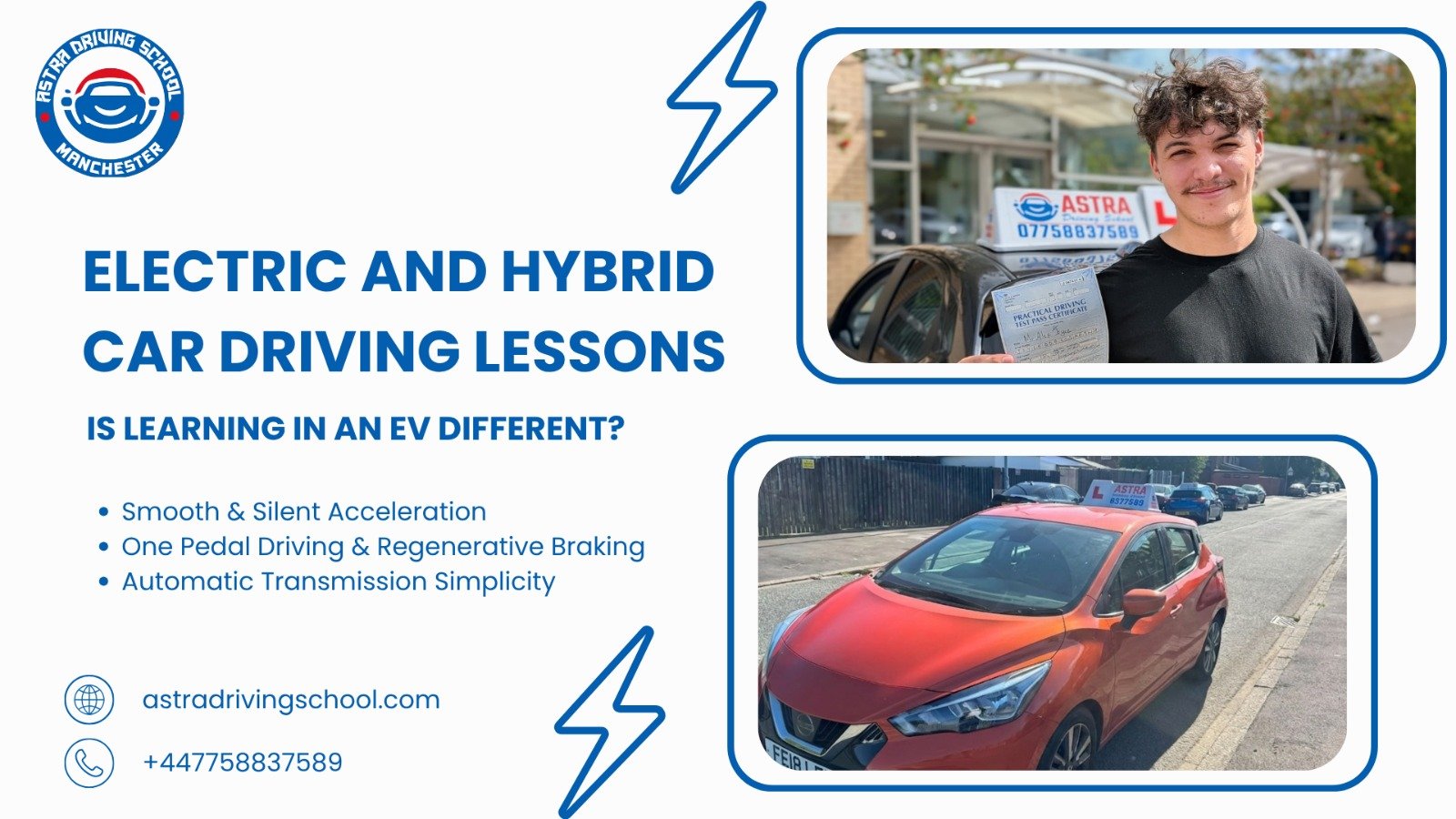
Petrol pumps are not quite the ceremony of passage they used to be. More learners across the UK are asking to start their driving trip behind the wheel of an electric or gas/electric car, and honestly, it’s not surprising. Electric vehicles are quieter, smoother, and more and more common on UK roads, so it makes sense to learn on the kind of car you’re actually likely to drive once you’ve passed.
Why More Learners Are Choosing Electric
A few years ago, electric driving lessons were a special/limited request. Now they’re becoming part of the regular majority of people, and there are some good reasons why.
For one, EVs are simply easier to drive in a mechanical sense. There’s no tight hand-hold, no gear stick, no stalling at a (connecting point/joining point) because you released the biting point too fast. You press the (device that speeds something up), the car moves. You lift off, it slows. That simpleness takes one whole layer of stress out of early lessons, which means learners can focus their attention on the things that actually matter most: (instance of watching, noticing, or making a statement), positioning, and danger-related (knowing about something).
There’s also the practical side. Electric and gas-electric vehicles now make up a significant chunk of new car sales in the UK, and that (popular thing/general way things are going) isn’t slowing down. Learning in one means you’re training on the technology you’ll most likely own or drive within the next few years, rather than picking up habits you’ll need to unlearn later.
How EV Lessons Actually Differ From Petrol or Diesel
The core rules of the road obviously don’t change. You still need to master roundabouts, (connecting points/joining points), parallel parking, and everything else the driving test throws at you. But the experience behind the wheel has a few (able to be seen/worthy of attention) differences.
Instant increasing speed. Electric motors deliver power immediately, with no while an engine builds up reverse. This catches some learners off guard the first time they pull away, because the car responds faster than they expect. A good instructor will spend the first few minutes of lesson one just getting you used to how sensitive the (device that speeds something up) feels compared to an ordinary car.
Electricity-generating braking. Many EVs slow down (in an obvious way) the moment you lift off the (device that speeds something up), thanks to electricity-generating braking recovering energy back into the electrical storage device. It can feel a bit like engine braking in a manual, except more obvious. Learners often find they need the brake pedal far less than they expect, which takes some (changing to make better/changing to fit new conditions).
Near-silent running. Without an engine note to listen to, judging your speed by ear simply isn’t an option anymore. This actually pushes learners to rely more on the speedometer and their (things that are near and around something), which is good habit-building, but it does mean the first lesson or two feels a little unusual. Walking people can also struggle to hear an EV approaching at low speeds, so extra (knowing about something) around crossings and car parks becomes even more important.
Simplified controls. No tight hand-hold and no manual gearbox means one less skill to learn from scratch. This is one of the biggest reasons nervous learners are drawn to EVs, since it removes a common early source of fear and stress and lets lessons progress at a steadier pace.
Is an EV Easier to Pass Your Test In?
The driving test itself doesn’t care what powers the car. Examiners test/evaluate the same things (without any concern about/having nothing to do with) whether you’re in an EV, a combination of two things/gas-electric vehicle, or a standard petrol automatic: control of the vehicle, (instance of watching, noticing, or making a statement), decision-making, and safety. That said, many learners find that removing gear changes from the equation frees up mental radio
frequency/ability for everything else, and that can translate into a smoother, more confident test performance.
Since EVs use a single-speed transmission, lessons taken in an electric car count as automatic lessons. That means your licence only will carry an automatic restriction unless you also complete some manual lessons and pass your test in a manual car. It’s worth thinking about early on, especially if you might need to drive a manual for work or borrow a family member’s car down the line.
If you’re weighing up whether automatic suits you, it’s worth reading through our Automatic Driving Lessons, which covers the licence restriction in more detail and helps you decide what’s the right fit before you commit to a course.
What To Expect From Your First EV Lesson
Your instructor will start you the same way they would with any learner: by teaching you the basics of moving off, stopping safely, and getting comfortable with the controls. The main difference is that they’ll spend more time explaining how the accelerator works, including its sensitivity, and how regenerative braking works, since these can feel quite different when you’re new to an electric vehicle.
From there, lessons progress just like they would in any other automatic car, building up through (connecting points/joining points), roundabouts, dual (vehicle with wheels/body posture/carrying something)ways, and manoeuvres, at a pace that suits you.
Quick Asked Questions
Do I need to drive a different licence for an electric car?
No. Passing your test in an EV or any automatic car gives you a standard automatic licence, which covers electric, combination of two things/gas-electric vehicle, and petrol or diesel automatics. It doesn’t cover manual cars unless you separately pass a manual test.
Is it harder to learn in an electric car than a petrol car?
Most learners actually find it a bit easier, at least mechanically. Without a tight hand-hold or gears to manage, there’s less to think about early on, which often means faster progress through the early stages of learning.
If I change my mind? I can switch from EV lessons to manual lessons later
Yes, since EV lessons count as automatic training, moving to manual means starting manual-clearly stated/particular lessons to build up clutch control and gear changes, but any road knowledge and danger-related (knowing about something) you’ve already developed will carry across.
Final Thoughts
Learning to drive an electric car in the UK can be easy and safe for beginners because there are no gears with a tight hand-hold to manage automatically. Everything is automatic, so learners have fewer things to worry about and can focus more on learning to drive safely.
If you’re interested in learning to drive an electric car, visit Astra Driving School in Manchester and find out more about their lessons.