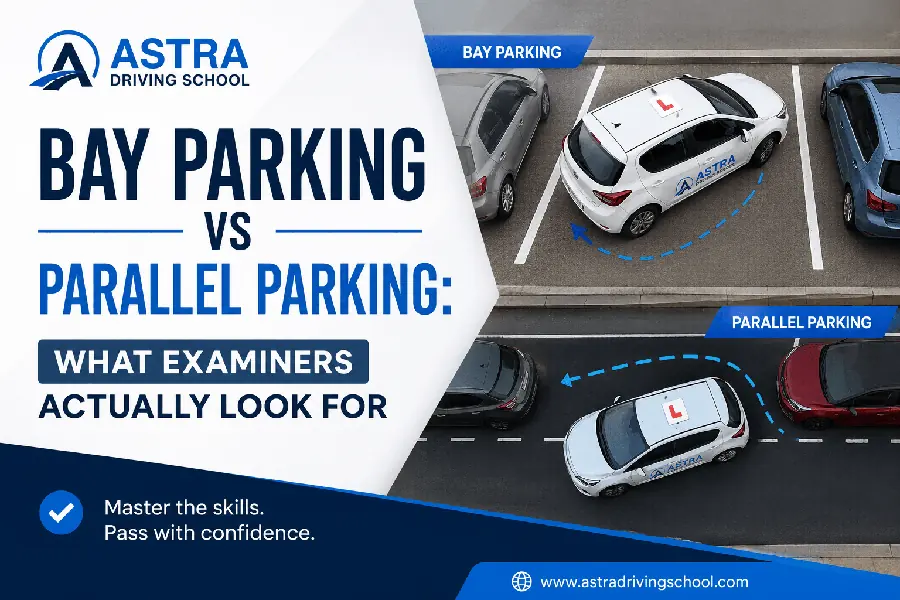

On the driving test you’ll be asked to do one reversing manoeuvre: parallel park at the side of the road, park in a bay (driving in and reversing out, or reversing in and driving out), or pull up on the right-hand side of the road, reverse about two car lengths and rejoin the traffic. The examiner chooses which one. All three are marked the same way: control, accuracy and, most of all, observation.
Lesson Journey: this guide is part of our lesson-by-lesson series for learner drivers.
- Lesson 1: The cockpit drill (DSSSM)
- Lesson 2: Moving off and stopping
- Lesson 3: Turning left (MSPSL)
- Lesson 4: Turning right (MSPSL)
- Lesson 5: Turning left at traffic lights
- Lesson 6: Turning right at traffic lights
- Lesson 7: Roundabouts
- Lesson 8: Multi-lane and spiral roundabouts
- Lesson 9: Emerging from junctions
- Lesson 10: Crossroads
- Lesson 11: Pedestrian crossings
- Lesson 12: Meeting traffic and passing parked cars
- Lesson 13: Hill starts
- Lesson 14: Dual carriageways
- Lesson 15: Driving test manoeuvres (you are here)
- Lesson 16: The emergency stop
- Coming next: getting ready for your driving test
Next: The emergency stop →
The Golden Rule: Slow Car, Fast Eyes
- Clutch control (manual) or brake control (automatic): keep the car at walking pace or slower, so you have time to steer and look.
- All-round observation: look all around before you start, and keep looking while you move, especially out of the back window when reversing.
- Stop and wait if someone comes: if a car or pedestrian approaches, stop and let them decide what to do. You won’t lose marks for waiting.
Parallel Parking
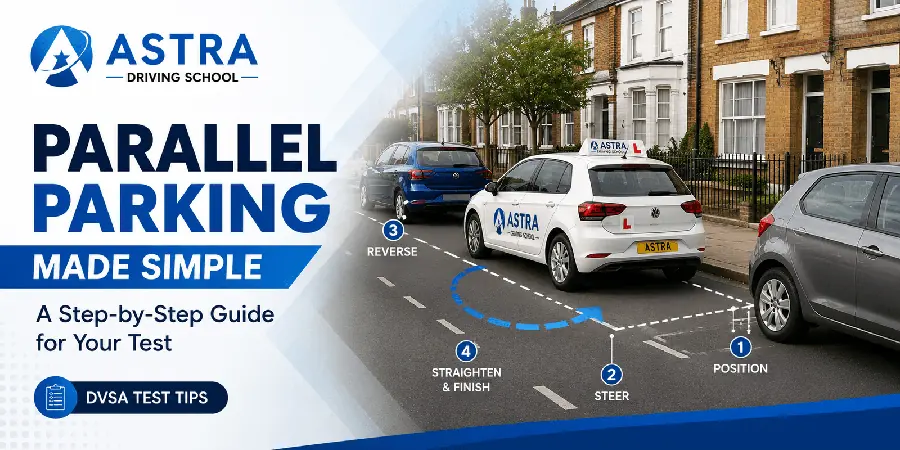
You pull up alongside a parked car, then reverse in behind it and park within about two car lengths, close to the kerb.
- Stop alongside the parked car, about half a metre to a metre away, with your rear bumpers roughly level.
- Check all around, then reverse slowly in a straight line until your reference point (your instructor will show you one) lines up.
- Steer left to bring the car in, check again, then steer right to straighten up as the car comes parallel to the kerb.
- Finish close to the kerb and reasonably straight. Small corrections are allowed.
For the full step-by-step method with reference points, see parallel parking made simple.
Bay Parking
Usually done at the test centre car park, at the start or end of the test. You may be asked to reverse into a bay and drive out, or drive into a bay and reverse out.
- Choose your bay and position the car so you have room to turn in.
- Look all around, then move slowly, steering a full lock at the point your instructor has taught you.
- Use both door mirrors to check the lines, and straighten up as the car comes into the bay.
- Finish inside the lines. Getting out to check, or going over a line, can cost marks, but you can correct your position.
Not sure which is easier? Read bay parking vs parallel parking.
Pulling Up on the Right
The examiner asks you to pull up on the right-hand side of the road when it’s safe, reverse about two car lengths, then rejoin the traffic.
- Crossing over: mirrors, signal right, and wait for a safe gap in the oncoming traffic before you cross. Pull up close and parallel to the right-hand kerb.
- Reversing: look all around, including your left blind spot for traffic coming from behind on the other side, then reverse slowly in a straight line, about two car lengths.
- Rejoining: do full observations in both directions. Traffic will be coming from ahead on your side and from behind on the other side, so take your time and signal if it would help.
Highway Code rule 239 says you shouldn’t park facing traffic at night, which is why this is only an exercise on the test. In everyday driving, pull up on the left where you can.
Common Mistakes
- Going too fast, so there isn’t time to look or correct the steering.
- Looking only in the mirrors and forgetting to look out of the back window.
- Not stopping when another road user approaches.
- Hitting or mounting the kerb, or finishing too far from it.
Why it matters on test day: manoeuvres test your steering control, and not having proper control of the steering is the 6th most common reason people fail. See the top 10 reasons people fail.
Learn It Properly With Astra
Our instructors teach simple reference points for every manoeuvre and practise them on quiet streets near you. Manual and automatic lessons across Greater Manchester, from £35 an hour, 7 days a week from 7am to 11:30pm.
Fill in the form and we’ll match you with an instructor near you, or call 07758 837589.
Sources
The Highway Code, GOV.UK. Checked 12 November 2026. Routines like DSSSM and MSPSL are how instructors teach the Highway Code; your instructor may use a slightly different version.
FAQs: Driving Test Manoeuvres
How many manoeuvres are on the driving test?
One. The examiner asks you to do one of the reversing exercises: parallel park, bay park, or pull up on the right and reverse about two car lengths.
Can I correct my position during a manoeuvre?
Yes. You can make small corrections, and stopping to correct is better than finishing badly. Too many corrections, or losing control, can cost marks.
Do I fail if I touch the kerb?
A light touch may be a minor fault. Mounting the kerb, or hitting it hard, is likely to be a serious fault.
Which manoeuvre is the hardest?
Many learners find parallel parking hardest at first, but with reference points from your instructor all three become routine.