
A mock driving test is a full practice test with your instructor, run and marked the same way as the real DVSA test. It shows you exactly where you would pick up faults, so you can fix them before test day. Most learners do at least one or two in the weeks before their test. If you can pass a mock comfortably, you are usually ready.
Lesson Journey: this guide is part of our lesson-by-lesson series for learner drivers.
- Lesson 1: The cockpit drill (DSSSM)
- Lesson 2: Moving off and stopping
- Lesson 3: Turning left (MSPSL)
- Lesson 4: Turning right (MSPSL)
- Lesson 5: Turning left at traffic lights
- Lesson 6: Turning right at traffic lights
- Lesson 7: Roundabouts
- Lesson 8: Multi-lane and spiral roundabouts
- Lesson 9: Emerging from junctions
- Lesson 10: Crossroads
- Lesson 11: Pedestrian crossings
- Lesson 12: Meeting traffic and passing parked cars
- Lesson 13: Hill starts
- Lesson 14: Dual carriageways
- Lesson 15: Driving test manoeuvres
- Lesson 16: The emergency stop
- Lesson 17: Your mock driving test (you are here)
- Coming next: test day
What the Real Test Includes
Your mock copies the real car driving test, which lasts about 40 minutes:
- Eyesight check: read a number plate from 20 metres away.
- Tell me question: one vehicle safety question at the start, such as how you would check the tyres. See tell me questions.
- General driving: on different roads and in different traffic, following the examiner’s directions.
- Independent driving: about 20 minutes following a sat nav or road signs. See the sat nav part of the test.
- One reversing manoeuvre: see Lesson 15: driving test manoeuvres.
- Show me question: one question while you drive, such as working the rear window demister.
- Possibly an emergency stop: see Lesson 16.
How a Mock Test Is Marked
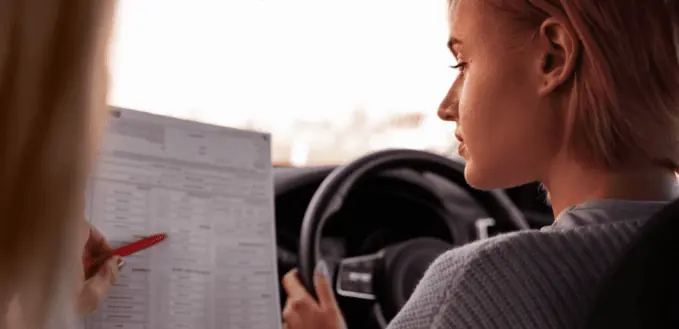
Your instructor marks the mock on the same sheet the examiner uses. There are three kinds of fault:
- Driving fault (a “minor”): not dangerous on its own. You can have up to 15 and still pass.
- Serious fault: something that could have been dangerous. One serious fault is a fail.
- Dangerous fault: real danger to you, the examiner or someone else. One dangerous fault is a fail.
The same minor fault repeated many times can be marked as serious, so look for patterns, not just the total.
How to Get the Most From Your Mock
- Treat it like the real thing: no chatting and no help from your instructor once it starts.
- Drive near your test centre: practise the junctions, roundabouts and road types you will meet on test day.
- Go through the marking sheet afterwards: ask what each fault was, and why.
- Plan your next lessons around the faults: fix the biggest ones first, then do another mock.
Signs You’re Ready for Your Test
- You pass mock tests with no serious or dangerous faults, more than once.
- You drive without your instructor prompting you.
- You can do every manoeuvre safely, and correct yourself if it goes wrong.
- You handle busy roundabouts, junctions and dual carriageways calmly.
- You can follow a sat nav or road signs on your own.
Nervous about the day itself? Read how to calm driving test nerves and what happens on your driving test.
Why it matters on test day: a mock shows up the faults behind the top 10 reasons people fail, such as junction observations and mirrors, while there is still time to fix them.
Back to the Lesson Journey for the full list.
Learn It Properly With Astra
Our instructors run mock tests on the roads around your test centre and go through every fault with you afterwards. Manual and automatic lessons across Greater Manchester, from £35 an hour, 7 days a week from 7am to 11:30pm.
Fill in the form and we’ll match you with an instructor near you, or call 07758 837589.
Sources
The Highway Code, GOV.UK. Checked 12 November 2026. Routines like DSSSM and MSPSL are how instructors teach the Highway Code; your instructor may use a slightly different version.
FAQs: Your Mock Driving Test
What is a mock driving test?
A full practice driving test with your instructor, run and marked the same way as the real DVSA test, so you can see where you would pick up faults.
How many minors can you get and still pass?
Up to 15 driving faults (minors). One serious or dangerous fault is a fail.
How long is the driving test?
About 40 minutes, including about 20 minutes of independent driving.
When should I do a mock test?
Usually in the last few weeks before your test, once you can drive without prompting. Many learners do two or three.